Research & Analysis
Share
WA
CEO & Editor-in-Chief


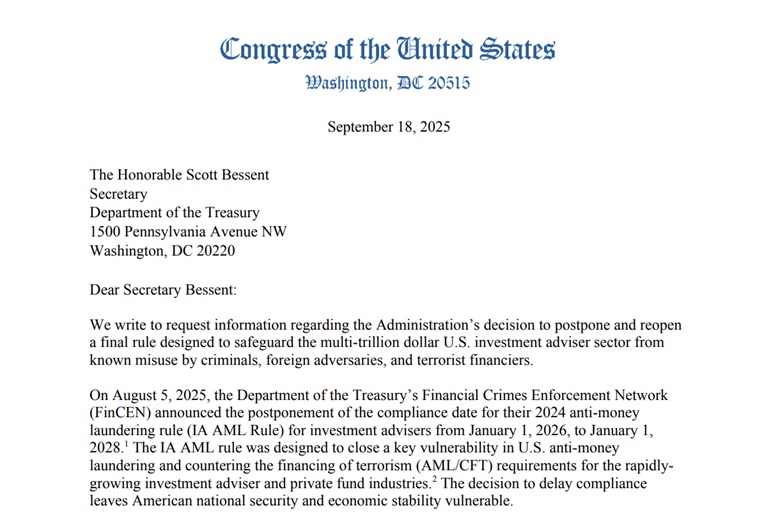
On September 18, senior lawmakers Elizabeth Warren, Maxine Waters, and Andy Kim sent a letter to Treasury Secretary Scott Bessent questioning the administration’s decision to postpone compliance with the Investment Adviser Anti-Money Laundering (IA AML) Rule until 2028.
The rule, finalized in 2024, was designed to close one of the most significant gaps in America’s anti-money laundering framework. By classifying investment advisers as “financial institutions” under the Bank Secrecy Act, it would have imposed customer due diligence, suspicious activity reporting, and program requirements similar to those long applied to banks and broker-dealers. With more than $140 trillion in assets managed by advisers, lawmakers argued that delaying implementation leaves the U.S. financial system exposed to illicit finance, foreign adversaries, and sanctioned entities.
The letter does not mention digital assets. Yet many crypto projects increasingly resemble traditional financial products — raising capital, managing assets, and issuing tokens that circulate widely. World Liberty Financial (WLFI), a high-profile venture linked to political figures, has issued both a governance token and a stablecoin.
At the same time, names such as Justin Sun continue to circulate in U.S. policy debates. Sun, long on the radar of regulators, has built projects that test the boundaries of compliance. The overlap between investment advisers, crypto products, and regulatory blind spots suggests that digital assets would naturally fall under the very rules now on hold.
The new compliance date of January 1, 2028 lands just a year before the end of President Trump’s term. The delay ensures that for nearly the entirety of his administration, advisers — whether in traditional finance or in crypto — are not bound by standardized AML obligations.
Legislation

Disclaimer of Warranty
The information provided in this article is for general informational purposes only. We make no warranties about the completeness, reliability, and accuracy of this information. Read full disclaimer
This timing matters. By running compliance out to the final year, the administration preserves the option to revisit, revise, or even rescind the rule, while avoiding enforcement battles during its term. Critics also note the broader pattern: the disbanding of Department of Justice anti-money laundering units and the narrowing of foreign bribery enforcement earlier this year.
The proximity of the new deadline to the end of Trump’s term raises further questions. Could politically linked financial ventures continue to operate with minimal oversight until then? And in the event of legal exposure, what role might presidential pardons play in shaping outcomes for those involved?
While the IA AML Rule appears technical, its implications are broad. It was designed not only to safeguard capital markets but also to prevent national security vulnerabilities, such as the use of private funds or advisory structures to channel money into sensitive U.S. technologies. Extending the compliance horizon effectively prolongs a well-documented blind spot.
For the digital asset sector, the consequences are even sharper. If crypto is to be treated on equal footing with traditional financial instruments, then AML standards should apply consistently. Yet with the rule delayed, questions remain about whether the space is being granted more time to expand in a regulatory vacuum.
Treasury has said it will “revisit the substance” of the rule during the delay. Whether this leads to stricter obligations, a weaker framework, or a reshaped rule altogether is still unclear.
What is certain is that the line between traditional finance, digital assets, and politics is blurring fast. As lawmakers push for answers, and as high-profile ventures like WLFI and figures such as Justin Sun remain in the spotlight, the real question is whether the U.S. can afford to wait until 2028 to close this gap in its financial defenses.



Editor's Picks

UAE Stablecoins: Why They Are Built to Travel, Not Stay Local

Walid Abou Zaki

Feb 28, 2026

8 min

The Central Bank of the UAE Clearing the Noise Around Article 62
Walid Abou Zaki
Feb 25, 2026
5 min

Europe’s Crypto Purge: Did Lithuania Just Kick Out Innovation — and is the UAE the Beneficiary?
Salma Naueihed
Feb 18, 2026
7 min
Read More Articles

In the Same Space

SEC Approves WisdomTree’s Instant-Settlement Tokenized Money Market Fund
News Desk
Feb 25, 2026
2 min
OCC Faces Scrutiny from Elizabeth Warren Over Trump-Linked Crypto Bank Bid
News Desk
Feb 27, 2026
3 min

European Central Bank Paper Flags Stablecoin Risks to Euro-Area Banks and Monetary Sovereignty
News Desk
Mar 4, 2026
3 min
Iran Crypto Outflows Surge 700 Percent After U.S. Israeli Strikes
News Desk
Mar 3, 2026
2 min

