Security & Audits
Share
AF
Head of Blockchain Forensic Investigations


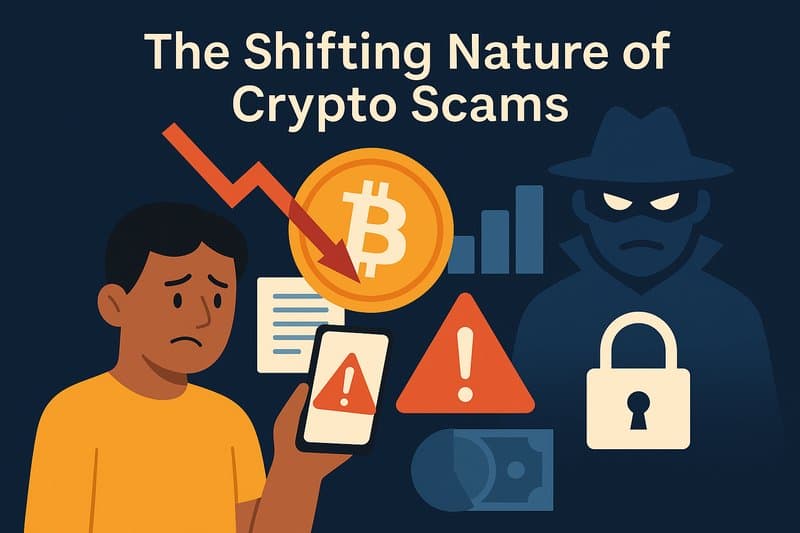
Cryptocurrency, while offering innovation and autonomy, also presents increasingly complex threats in 2025, with global losses due to fraud now surpassing USD 12 billion annually, a 20% year-on-year increase.
Experts conservatively estimate the true scale to be at least double the official figures due to underreporting.
This isn't just a law enforcement issue; it's a public safety concern, a technological arms race, and a global challenge in behavioral economics. In fact, the digital asset space has become a mainstream financial environment, attracting sophisticated predators who leverage technology and human vulnerability.
In 2025, crypto fraud has evolved from unsophisticated phishing links and fake ICOs to multinational fraud networks and technical attack vectors embedded in decentralized protocols.
Scammers now blend highly technical exploits, such as smart contract manipulation and cross-chain bridge attacks, with deeply human scams like fake romance and false recovery services. This "hybridisation of attack surfaces" makes current fraud insidious and resistant to traditional detection.
The success of these scams lies in their ability to bypass critical thinking and exploit human psychology, manipulating trust, urgency, and hope. Victims are often financially savvy professionals, small business owners, and even crypto enthusiasts who experience a "lapse in emotional security".
Scammers use legitimate technologies for malicious purposes, employing automated trading bots, crafting false transparency with blockchain explorers, and deploying smart contracts that appear decentralized but grant single-actor control.
The widespread use of AI-generated content, including deepfake videos, cloned voice notes, and personalized phishing messages, has become the norm, making impersonation dangerously convincing. This marks a significant evolution: fraud is now data-driven and behavioral, personalizing scams at scale.
Scammers are highly adaptive, shifting tactics overnight in response to regulatory changes or takedowns. A striking trend is the rise of "fraud-as-a-service," with subscription-based offerings on the dark web providing hosted scam websites, phishing kits, and even pre-written social media scripts. Many fraud operations are professionalized, run by full-time, salaried teams with dedicated personnel for technical deployment, social manipulation, and financial offboarding.
The sources break down several prevalent scam categories:
Scams operate like structured businesses, following a five-phase lifecycle:
1. Identification and Targeting: Scammers identify targets via scraped data or prior breaches, assigning them to specialized "handlers" who initiate contact through personalized messages, often on platforms like WhatsApp or Telegram.
2. Grooming and Trust Building: The longest phase, where fraudsters build trust through consistent, friendly communication, positioning themselves as helpful mentors or romantic partners. Small initial deposits with quick returns build confidence.
3. Escalation and Extraction: Once trust is established, pressure mounts to invest larger sums, with fake gains displayed on platform dashboards. Withdrawal attempts are met with delays or demands for more funds (e.g., "taxes," "unlock fees").

Disclaimer of Warranty
The information provided in this article is for general informational purposes only. We make no warranties about the completeness, reliability, and accuracy of this information. Read full disclaimer
4. Exit and Obfuscation: The scam concludes, platforms shut down, and stolen funds are laundered by being split, bridged across chains, mixed through privacy tools, and routed through dozens of wallets before off-ramping.
5. Recycling and Retargeting: Victim data is recycled and sold, often leading to fake recovery service pitches.
Modern scams rely on sophisticated infrastructure, including fake platforms and apps that mirror legitimate ones and are often hosted on offshore servers. They use smart contracts with malicious backdoors that appear legitimate but contain hidden functions for draining or freezing funds. To cover tracks, fraudsters employ transaction obfuscation tools like mixers, privacy coins, and cross-chain bridges.
Victim behavior is key to understanding scams, as fraudsters exploit inherent human traits like trust bias, authority bias, sunk cost fallacy, social proof, and fear of missing out (FOMO).
Preventing fraud requires critical awareness and verification. Key red flags include:
Practical preventative habits include: always verifying identities independently, never clicking unverified links, using reputable wallets and platforms, enabling multi-factor authentication (MFA), checking smart contract audits, and using read-only wallet connections or empty "burner" wallets for new DApps. Becoming familiar with block explorers (e.g., Etherscan) to track transactions is also crucial.
When fraud occurs, blockchain forensics is crucial. Unlike cash, cryptocurrencies are traceable by design, with every transaction etched into an immutable ledger. Forensic investigators analyze transaction trails using block explorers, specialized forensic platforms (e.g., Chainalysis), smart contract analysis tools, and Open Source Intelligence (OSINT) to identify illicit activity, track asset movement, and attribute wallets to real-world identities. Timing is critical; the sooner forensic investigation begins, the higher the chance of tracing and freezing funds before they are fully laundered.
For victims, legal strategies begin with forensic evidence. Key legal tools include:
Full recovery of stolen assets is rare (~5-10%), but partial recovery is common (~40-50%). Recovery depends on the timing of the report, use of centralized infrastructure, quality of forensic evidence, and jurisdictional reach. Even if funds aren't fully returned, forensic evidence can lead to enforcement, regulatory action, and disruption of scam operations. Victims are encouraged to report, as shame or self-blame can deter action, but scams are engineered to be convincing, and the only mistake is silence.
Institutions are increasingly targeted for crypto fraud, including client onboarding fraud, vendor impersonation, and internal compromises. To manage this, risk management programs should focus on:
Future trends indicate more sophisticated fraud, including:
The future of prevention relies on education as infrastructure, embedding user awareness directly into wallet interfaces, exchanges, and public campaigns.
Ultimately, fighting crypto fraud requires a collaborative path forward, involving individuals, platforms, institutions, legal professionals, and regulators working together to share intelligence, standardize processes, and foster a culture of vigilance rather than shame.
For more information on Blockchain Forensics and Legal Services firm, Crypto Legal, click here.
Related Articles

Editor's Picks

UAE Stablecoins: Why They Are Built to Travel, Not Stay Local

Walid Abou Zaki

Feb 28, 2026

8 min

The Central Bank of the UAE Clearing the Noise Around Article 62
Walid Abou Zaki
Feb 25, 2026
5 min
Europe’s Crypto Purge: Did Lithuania Just Kick Out Innovation — and is the UAE the Beneficiary?
Salma Naueihed
Feb 18, 2026
7 min
Read More Articles

In the Same Space

Solana ETFs Attract Institutional Investors While XRP Funds Lean Retail
News Desk
Mar 11, 2026
4 min

GCEX Expands Institutional Offering with Tokenized Gold Trading
News Desk
Mar 11, 2026
2 min

U.S. Senators Negotiate Stablecoin Rewards Compromise in Market Structure Bill
News Desk
Mar 11, 2026
4 min

Nasdaq Collaborates with Kraken’s Parent Payward on Tokenized Equity Infrastructure
News Desk
Mar 11, 2026
4 min