Companies & Deals
Share
The U.S. House Committee on Financial Services has approved the Digital Asset Market Clarity Act (CLARITY Act), a significant piece of legislation aimed at defining regulatory boundaries in the crypto space. The bill will now move to the House floor for a full vote.
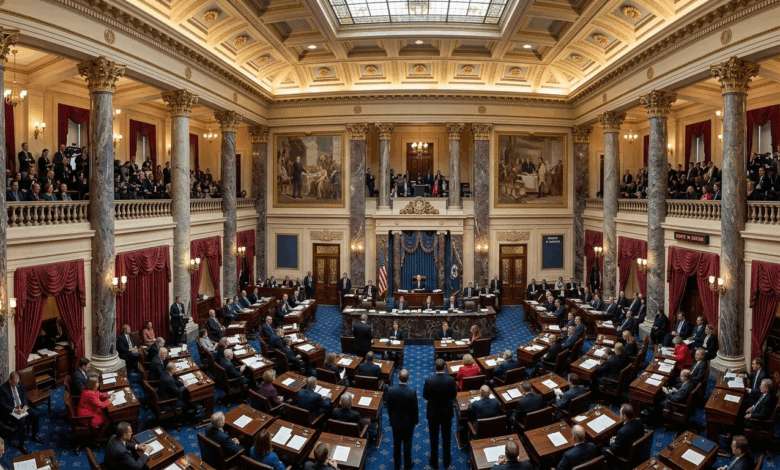
The committee voted 32–19 in favor of advancing the bill on Tuesday, following the House Agriculture Committee’s earlier approval with a 47–6 vote. The session, held at the Rayburn House Office Building, featured bipartisan debate.
“This is the second bill that Bryan Steil has ably led, first stablecoins and now a market structure bill,” said Representative French Hill, the bill’s sponsor, shortly after the vote passed.
Steil, who chairs the House Crypto Subcommittee, hailed the development as “a big step forward,” adding that it was “great to see” Hill’s legislation clearing both committees.
Hill emphasized the broader impact of the bill: “This is an opportunity for America to lead in the future of Web3 on the internet, including financial services using tokenized payments.”
The CLARITY Act aims to settle the long-standing question of which regulator should oversee which parts of the crypto ecosystem. Under the proposed framework, the Commodity Futures Trading Commission (CFTC) would supervise crypto tokens classified as digital commodities, while the Securities and Exchange Commission (SEC) would retain authority over crypto assets considered securities.
Committee Chairman Glenn “GT” Thompson explained, “The Clarify Act provides certainty on digital assets to market participants… It brings needed customer protections to digital assets-related activities and intermediaries.” He expressed hope that the bill could create a more equitable and transparent regulatory environment for the U.S. crypto industry.
Representative Angie Craig also underscored the urgency of moving forward. “This is not a perfect bill,” she admitted, “But if we don’t act, it will grow without the consumer protections that retail investors need and deserve.”
Legislation

Disclaimer of Warranty
The information provided in this article is for general informational purposes only. We make no warranties about the completeness, reliability, and accuracy of this information. Read full disclaimer
Prior to the vote, lawmakers debated changes to the bill that would expand the SEC’s authority. One such provision, informally dubbed the “Gensler-era provision,” would allow the SEC to individually designate tokens as securities—even if those tokens had already been approved or sold. Critics argue this measure could perpetuate the very uncertainty the bill aims to eliminate.
Some pointed to past SEC actions as examples of regulatory inconsistency, such as the agency’s initial position that Ethereum wasn’t a security, followed by legal action against Ripple.
In parallel, support has emerged for including the Blockchain Regulatory Certainty Act (BRCA) within the legislation. Firms such as Uniswap, Jump, and Coin Center back the BRCA, which aims to shield blockchain developers who do not control user funds from regulatory burdens.
Earlier this week, Rep. Hill introduced an amendment addressing the classification of “non-controlling blockchain developers.” The amendment clarifies that these developers would not be considered “money transmitters” or subject to related registration requirements.
Despite growing support, some Democrats remain opposed. Representative Maxine Waters proposed an amendment to address potential conflicts of interest involving former President Donald Trump’s crypto-related ventures. She cautioned that he could “use the bill to personally enrich himself and his family.”
Representative Brad Sherman introduced a separate amendment seeking to block what he described as future “bailouts” for the crypto industry.
Looking ahead, the spotlight now turns to the GENIUS Act — proposed legislation focused on regulating stablecoins. “The GENIUS Act is one step closer to passage, a huge milestone for the crypto community,” said U.S. Crypto and Artificial Intelligence (AI) Czar David Sacks in a post on X on Tuesday (June 10).
The bill will need to secure 60 votes in the Senate to overcome a filibuster before it can proceed to a final vote.
Touted as a pivotal moment in the evolution of digital asset regulation, the GENIUS Act could be signed into law within three weeks if it successfully passes through Congress. Its passage would likely mark a turning point for institutional blockchain adoption, offering much-needed regulatory clarity and reducing legal ambiguity.




Editor's Picks

UAE Stablecoins: Why They Are Built to Travel, Not Stay Local

Walid Abou Zaki

Feb 28, 2026

8 min

The Central Bank of the UAE Clearing the Noise Around Article 62
Walid Abou Zaki
Feb 25, 2026
5 min

Europe’s Crypto Purge: Did Lithuania Just Kick Out Innovation — and is the UAE the Beneficiary?
Salma Naueihed
Feb 18, 2026
7 min
Read More Articles

In the Same Space

SEC Approves WisdomTree’s Instant-Settlement Tokenized Money Market Fund
News Desk
Feb 25, 2026
2 min

European Central Bank Paper Flags Stablecoin Risks to Euro-Area Banks and Monetary Sovereignty
News Desk
Mar 4, 2026
3 min

Iran Crypto Outflows Surge 700 Percent After U.S. Israeli Strikes
News Desk
Mar 3, 2026
2 min

OCC Faces Scrutiny from Elizabeth Warren Over Trump-Linked Crypto Bank Bid
News Desk
Feb 27, 2026
3 min


