Exchanges & Trading
Share
WA
CEO & Editor-in-Chief


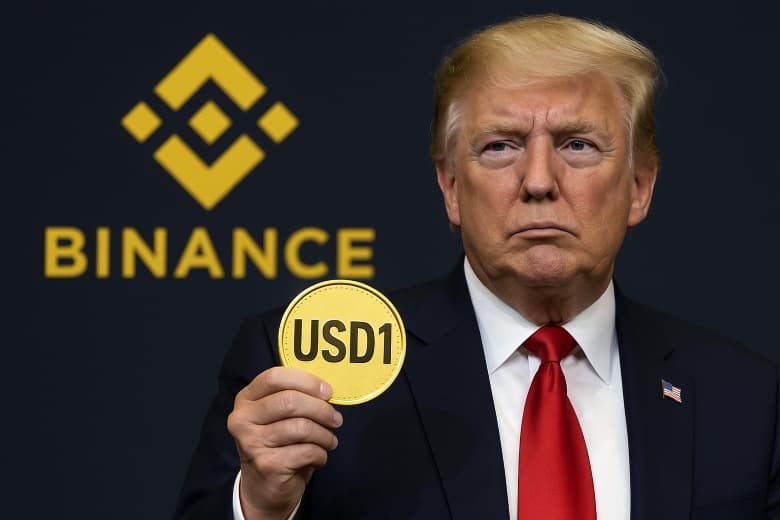
The Trump-linked stablecoin USD1, backed by World Liberty Financial (WLFI), has stormed into the crypto spotlight—thanks to a $2 billion investment routed through it by Abu Dhabi’s MGX and a high-profile listing on Binance. The USD1–MGX–Binance triangle is more than just a financial story; it's a geopolitical signal. And the results? One of the most explosive stablecoin launches in recent memory.
In a single move, USD1 didn’t just gain traction—it gained its entire market cap. And the controversial giant Binance, long painted as the villain in U.S. political circles, is now wrapping this token in full support.
On May 22, Binance officially listed USD1. The results were immediate: over $400 million in daily trading volume in the days following, with the token now commanding a market cap of $2.15 billion. By contrast, PayPal's PYUSD, launched with far less controversy and more corporate polish, floats steadily below $1 billion in market cap, with daily volumes hovering around $25 million.
What's more? USD1 is built on the BNB Chain—Binance's native infrastructure. Binance provided the rails, the liquidity, and now the exchange listing, essentially turning itself into the launchpad for a politically-charged digital dollar. The irony couldn't be thicker.
Investment
Launching

Disclaimer of Warranty
The information provided in this article is for general informational purposes only. We make no warranties about the completeness, reliability, and accuracy of this information. Read full disclaimer
Over 99% of USD1’s trading volume happens on Binance, with other exchanges barely registering. HTX, for instance, reports under $10 million in daily volume, while Bitget and others see only single-digit millions. Binance isn’t just listing USD1—it’s powering it.
MGX's role? Instrumental. Without its $2B transaction, USD1 would still be an obscure stablecoin sitting far outside the top 10. But thanks to this deal—and its conversion into pure on-chain volume—the token is now being talked about in the same breath as Tether and USDC. It was an investment, yes. But more than that, it was a market cap injection.
The political fallout has been swift. U.S. Senators have raised concerns over the ethical entanglement of a Trump-branded crypto asset being used in billion-dollar international financial flows. The GENIUS Act, meant to regulate stablecoins, lost steam once WLFI and USD1 hit headlines. And while criticism mounts in Washington, Binance seems unfazed, offering volume, visibility, and validation.
If tariffs were Trump’s trade weapon of choice, USD1 is now his crypto chess piece. And the board just got global.
The question now is: what’s next in Trump’s digital asset playbook? A Trump NFT revival? A "TruthCoin" tied to social media engagement? Or maybe a MAGA token launched on Solana during election season? Whatever rabbit he pulls out of his red hat next, one thing is clear: USD1 is no sideshow. With MGX backing it, Binance powering it, and regulators watching closely, this stablecoin may have just redefined what political capital looks like in the Web3 era.

Editor's Picks
UAE Stablecoins: Why They Are Built to Travel, Not Stay Local

Walid Abou Zaki

Feb 28, 2026

8 min

The Central Bank of the UAE Clearing the Noise Around Article 62
Walid Abou Zaki
Feb 25, 2026
5 min

Europe’s Crypto Purge: Did Lithuania Just Kick Out Innovation — and is the UAE the Beneficiary?
Salma Naueihed
Feb 18, 2026
7 min
Read More Articles

In the Same Space
Binance, Iran, and the Question of Narrative at a Critical Moment
News Desk
Feb 26, 2026
5 min
CFTC Signals Imminent Launch of U.S. Crypto-Linked Perpetual Futures
Salma Naueihed
Mar 4, 2026
3 min
Senate Housing Bill Adds Temporary CBDC Ban Through 2030
News Desk
Mar 3, 2026
2 min
JPMorgan Says CLARITY Act Could Spark Crypto Rally in Second Half
News Desk
Mar 2, 2026
2 min

